
The team at ‘Le Girofard’, the LGBTQIAP+ centre of Bordeaux, generously offered their offices to conduct this activity in a safe environment. Le Girofard was familiar to the participants. They felt free to speak about their experience in their countries of origin and with the asylum system in France.
Indeed, freedom has proven to be pivotal for my interlocutors. They affirmed they seek the freedom in France to be true to themselves in matters of sexual orientation and gender identity. It is more than a simple search to be free. Freedom is hope, or, as one of my interlocutors put it: “l’espoir d’avoir une liberté.” Hoping to be free must resonate among many LGBTIQ+ with experiences of asylum and forced displacement around the world. In France, however, ‘liberté’ takes another significance as it is anchored in the nation’s motto: liberté, égalité, fraternité.
Unfortunately, these three ideals may not be guaranteed to everyone. The participants in the workshop search for freedom away from the controlling gaze of their family and state in their countries of origin: “vivre sans le regard des autres” [“To live without the gaze of others”]. They face, however, potential rejection by the French asylum system. Rahma (a pseudonym) shared that the French Office for the Protection of Refugees and Stateless Persons (OFPRA) rejected her asylum application. She suspects that was because of the cultural difference between her country of origin, Côte d’Ivoire, and France. As she said:
“I would like them to consider that… we have different educational backgrounds; we were brought up differently […] I would also like them to take our realities into account before imposing sanctions on us so harshly. Because I feel that the sanction is just a bit too, too harsh. We come here seeking refuge. We don’t want to be psychologically hurt even further.”
Her use of ‘imposing sanctions’ is telling of how LGBTIQ+ with experiences of asylum may perceive their relation to asylum systems in host countries. Imposing sanctions is not merely a distant decision by the agents of the system. It is a verdict that has lasting consequences on the lives of those who are vulnerable.
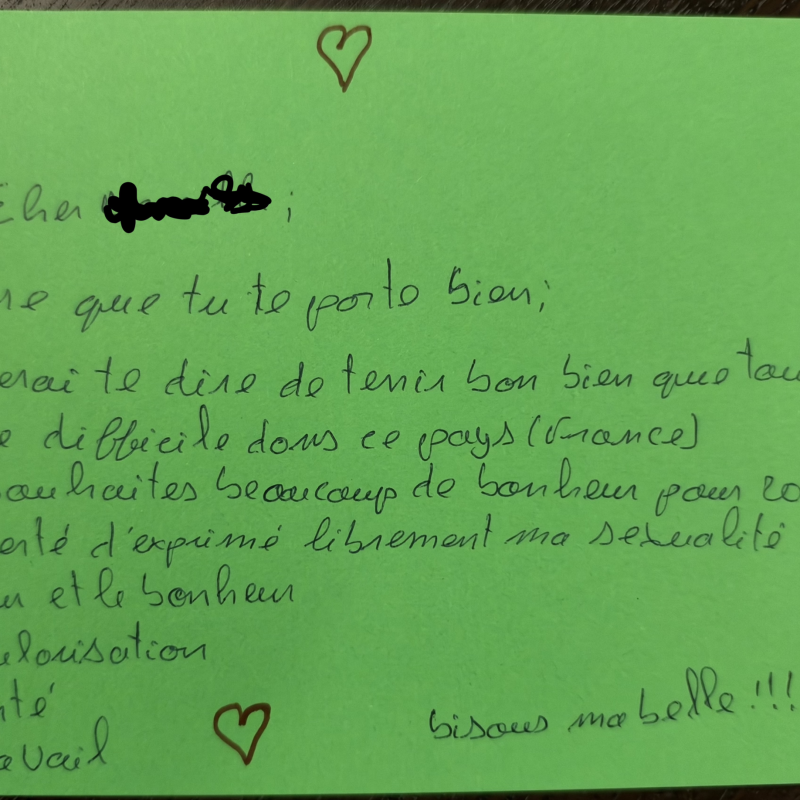
To close the workshop, I invited each participant to write a postcard to her future self. Rahma’s postcard brought the discussion of freedom into the everyday: being able to express her sexuality, finding love, securing legal status, staying healthy and working. She wrote:
Dear Rahma,
I hope you’re doing well. I’d like to tell you to stay strong even though everything seems difficult here in France. I wish you lots of happiness in 2027.
Kisses, beautiful.
The team at ‘Le Girofard’, the LGBTQIAP+ centre of Bordeaux, generously offered their offices to conduct this activity in a safe environment. Le Girofard was familiar to the participants. They felt free to speak about their experience in their countries of origin and with the asylum system in France.
Indeed, freedom has proven to be pivotal for my interlocutors. They affirmed they seek the freedom in France to be true to themselves in matters of sexual orientation and gender identity. It is more than a simple search to be free. Freedom is hope, or, as one of my interlocutors put it: “l’espoir d’avoir une liberté.” Hoping to be free must resonate among many LGBTIQ+ with experiences of asylum and forced displacement around the world. In France, however, ‘liberté’ takes another significance as it is anchored in the nation’s motto: liberté, égalité, fraternité.
Unfortunately, these three ideals may not be guaranteed to everyone. The participants in the workshop search for freedom away from the controlling gaze of their family and state in their countries of origin: “vivre sans le regard des autres” [“To live without the gaze of others”]. They face, however, potential rejection by the French asylum system. Rahma (a pseudonym) shared that the French Office for the Protection of Refugees and Stateless Persons (OFPRA) rejected her asylum application. She suspects that was because of the cultural difference between her country of origin, Côte d’Ivoire, and France. As she said:
“I would like them to consider that… we have different educational backgrounds; we were brought up differently […] I would also like them to take our realities into account before imposing sanctions on us so harshly. Because I feel that the sanction is just a bit too, too harsh. We come here seeking refuge. We don’t want to be psychologically hurt even further.”
Her use of ‘imposing sanctions’ is telling of how LGBTIQ+ with experiences of asylum may perceive their relation to asylum systems in host countries. Imposing sanctions is not merely a distant decision by the agents of the system. It is a verdict that has lasting consequences on the lives of those who are vulnerable.
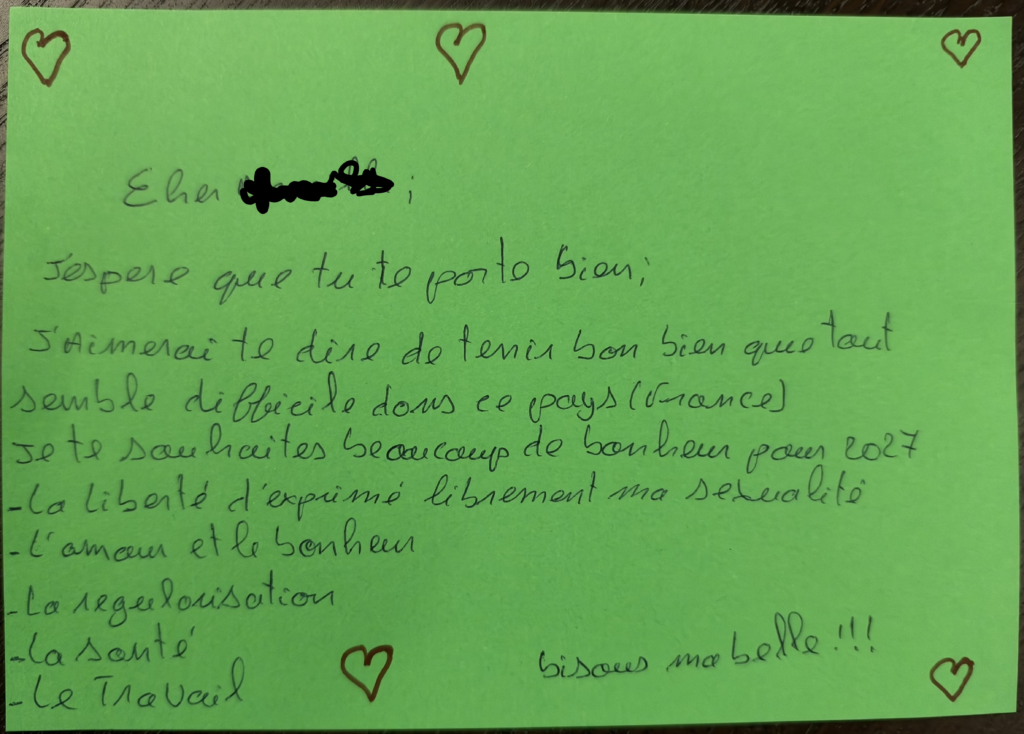
To close the workshop, I invited each participant to write a postcard to her future self. Rahma’s postcard brought the discussion of freedom into the everyday: being able to express her sexuality, finding love, securing legal status, staying healthy and working. She wrote:
Dear Rahma,
I hope you’re doing well. I’d like to tell you to stay strong even though everything seems difficult here in France. I wish you lots of happiness in 2027.
Kisses, beautiful.